

[ad_1]
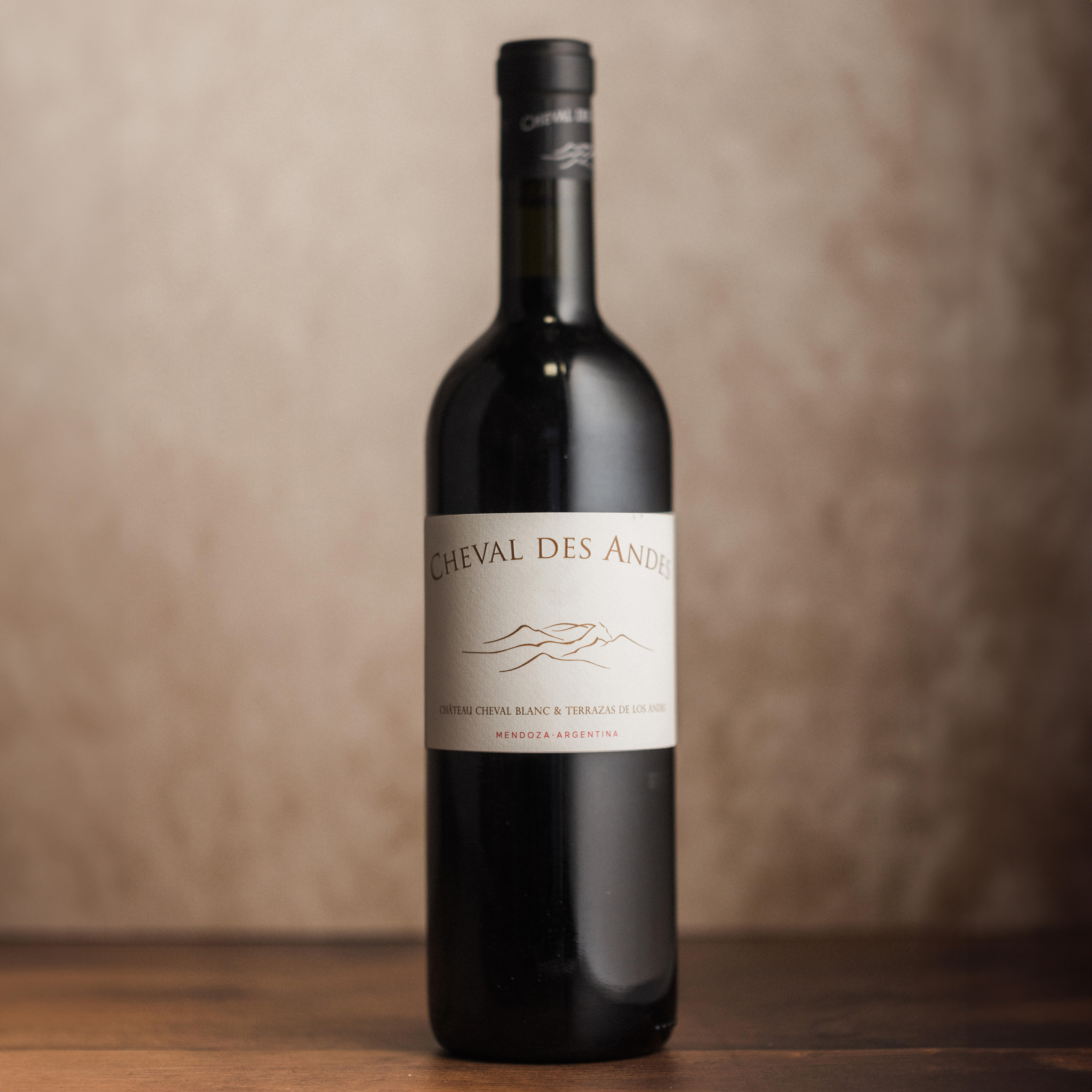
There’s one thing thrilling occurring at Château Cheval Blanc’s outpost within the Andes. Forward of the discharge of 2021 Cheval des Andes as a part of our La Place de Bordeaux supply, Charlie Geoghegan finds out extra.
“Cheval des Andes will not be a standard Argentinian wine, and it’s not what it was 15 years in the past.”
So says Arnaud de Laforcade, monetary and business director at Château Cheval Blanc – and this, its sibling property on the opposite aspect of the world. He’s at No.3 St James’s Avenue to indicate us the brand new 2021 classic, about to be launched by way of La Place de Bordeaux.
Based as a three way partnership between Cheval Blanc and the Mendoza-based Terrazas de los Andes in 1998, Cheval des Andes has undergone a change over the past decade or so.
The property has 47 hectares of vines, break up between two of Mendoza’s most prized areas: Las Compuertas, a part of Luján de Cuyo; and a smaller share in Paraje Altamira within the Uco Valley. However till 2014, the wine itself was produced from a broader number of vines, together with a few of Terrazas’s greatest parcels.
Then one thing modified.
From model to land
The early 2010s noticed higher involvement right here from “the brand new era at Cheval Blanc”, together with Arnaud and his colleague Pierre-Olivier Clouet, technical director-turned-CEO. Issues acquired a bit philosophical, they usually started to marvel what a three way partnership ought to, or may, be.
Cheval des Andes was a blended wine, assembled with care and precision like a advantageous Champagne. However this was not the Cheval Blanc crew’s forte. “Why would we now have any legitimacy in mixing in Argentina?” they requested themselves. “We don’t know something about blends.”
Again in St Emilion, Cheval Blanc is, after all, a mix – of grape varieties and parcels. However the strategy to mixing there may be deceptively easy – and just a bit bit radical. Somewhat than beginning with a clean slate and increase, “it’s simply taking away the weak plots,” Arnaud says.
It jogs my memory of marking within the French schooling system; as pals have described it, the scholar begins with a doable 20 marks out of 20, and it’s the instructor’s job to take away factors from the utmost moderately than the inverse.
Pierre-Olivier Clouet as soon as informed me that he would use 100% of the grapes at Cheval Blanc for the grand vin there if he may, if the standard allowed. An excellent classic in his thoughts is one the place the whole lot is so excessive in high quality that there’s merely no second wine. He will get his approach typically, as he did in 2015 and 2022.
They will afford to do that at Cheval Blanc as a result of the wine comes from a particular place that they know intimately, and over which they’ve whole management. Issues operated a bit in another way at Cheval des Andes, calling for a change – “going from a model to a progress,” Arnaud says.
A change of tempo
And so, with the 2015 classic, these 47 hectares turned the only real grape supply for Cheval des Andes. In tandem got here a wholesale reconsidering of the winery: replanting the place needed and questioning established practices on pruning and selecting.
These developments got here at a welcome change of tempo from Arnaud’s dwelling patch. “In St Emilion, the whole lot strikes slowly,” he laments. “In Argentina, there’s a way of freedom. If you wish to change your harvest date, you possibly can.” So that they did.
Previously, harvest at Cheval des Andes happened in early Might. Now, it’s in early March and even the top of February; it was 4th-Nineteenth March in 2021.
You could possibly transfer quick in Argentina, however that doesn’t imply you accomplish that recklessly. The choice to choose early must be made properly earlier than harvest, initially of the season. “To have balanced grapes,” Arnaud says, “you’ll want to inform the vines you’ll be selecting early.”
Some folks will let you know that there’s little to no classic variation in Argentina. The vagaries of 1 yr, the logic goes, are usually not all that completely different from the following – and the influence on the wine is minimal, in any occasion. Arnaud will not be so positive. It could ring true, he says, for these wines the place oak and extraction play the important thing function. Strip out the heavy winemaking hand, although, and also you is likely to be shocked: “Begin selecting earlier, cease all the brand new oak, enhance the dimensions of the ageing vessels and you allow room for nuance, for a extra delicate expression of the classic impact.”
There may be one space through which Cheval des Andes sees little or no variation: the dimensions of the crop. Cheval Blanc is a not incomparable 39 hectares of vines, although the yield there can differ broadly, Arnaud says: “100,000 bottles one yr, 40,000 the following.” At Cheval des Andes, they see a far steadier 90-120,000 bottles every year. Arnaud places this all the way down to the water provide.
The local weather in Mendoza is simply too dry to viably develop grapes with out irrigation, he says. Although not permitted in Bordeaux, irrigation is a truth of viticultural life right here. Enhancements in irrigation on the property, together with the set up of a reservoir and the sparing, focused strategy of drip irrigation (versus the extra one-size-fits-all flood irrigation) have helped enormously. Irrigating solely when and particularly the place it’s needed to take action has given them steadier yields – and an enormous enchancment within the ripeness stage of the Cabernet Sauvignon.
The Bordeaux affect
There’s a clear Bordelais affect right here – within the strategy and within the last wine. Cheval des Andes was conceived partially by Pierre Lurton, among the many most vital figures of his era in Bordeaux. As we speak it’s overseen by the uber-talented Pierre-Olivier Clouet and Gérald Gabillet, in partnership with the native crew.
For those who tasted it blind and thought it was a Bordeaux, you may be forgiven. The tannins are refined, there’s a Cabernet-derived leafy word, there’s loads of spice – and there’s stability. It is a harmonious wine from the off; tasting Cheval des Andes, even the just-released 2021 classic, isn’t onerous work.
However there’s extra to it. This isn’t simply one other Bordeaux mix from Argentina, neither is it purely a Cheval Blanc lookalike. The not-so-secret ingredient right here is Malbec. Argentinian Malbec is ubiquitous now on grocery store cabinets, however the grape itself is native to the South West of France (Cahors moderately than close by Bordeaux, however shut sufficient). It was a major presence in Bordeaux till Phylloxera and, later, frosts, all however wiped it out. It stays on the books immediately as a permitted grape for pink Bordeaux, although plantings are minuscule. There may be, notably, half a hectare of Malbec now planted at Cheval Blanc; watch this house.
The Malbec at Cheval des Andes hits a bit completely different, although. Malbec makes up just below half the mix in 2021, alongside 49% Cabernet Sauvignon and three% Petit Verdot. There’s extra to Malbec than the over-ripe fruit bomb for which it’s typically disparaged, Arnaud believes. He likens it, to my shock, to Pinot Noir: “Earthy, gently floral, comparatively low tannins, and stability between alcohol and acidity.”
Put all of it collectively, and there’s one thing very thrilling occurring at Cheval des Andes. The 2021 will not be overly showy at this early stage, extra delicate and reserved. However there may be a substantial amount of complexity while you go in search of it. There may be fantastically pure fruit, with properly outlined blackberry coulis and blueberry notes, together with dusty darkish chocolate and cocoa-powder character. It’s all a bit tightly coiled for now, however there’s spicy black fruit and tobacco able to reveal itself. An underlying spicy edge is peeking out, although that fruit stands out above all. Nice tannins and full of life acidity point out a vibrant future.
The 2021 classic of Cheval des Andes will likely be launched subsequent week.
[ad_2]